The Norwegian Fjords by Ship: Season, Ports and What to Expect
Sheer cliffs, waterfalls and villages at the end of long arms of the sea. A practical guide to when to go, which fjords matter and how to dress for all four seasons in a day.

AI-assisted article, reviewed and edited by the Voyage Current editorial team. Images are AI-generated. How we work.
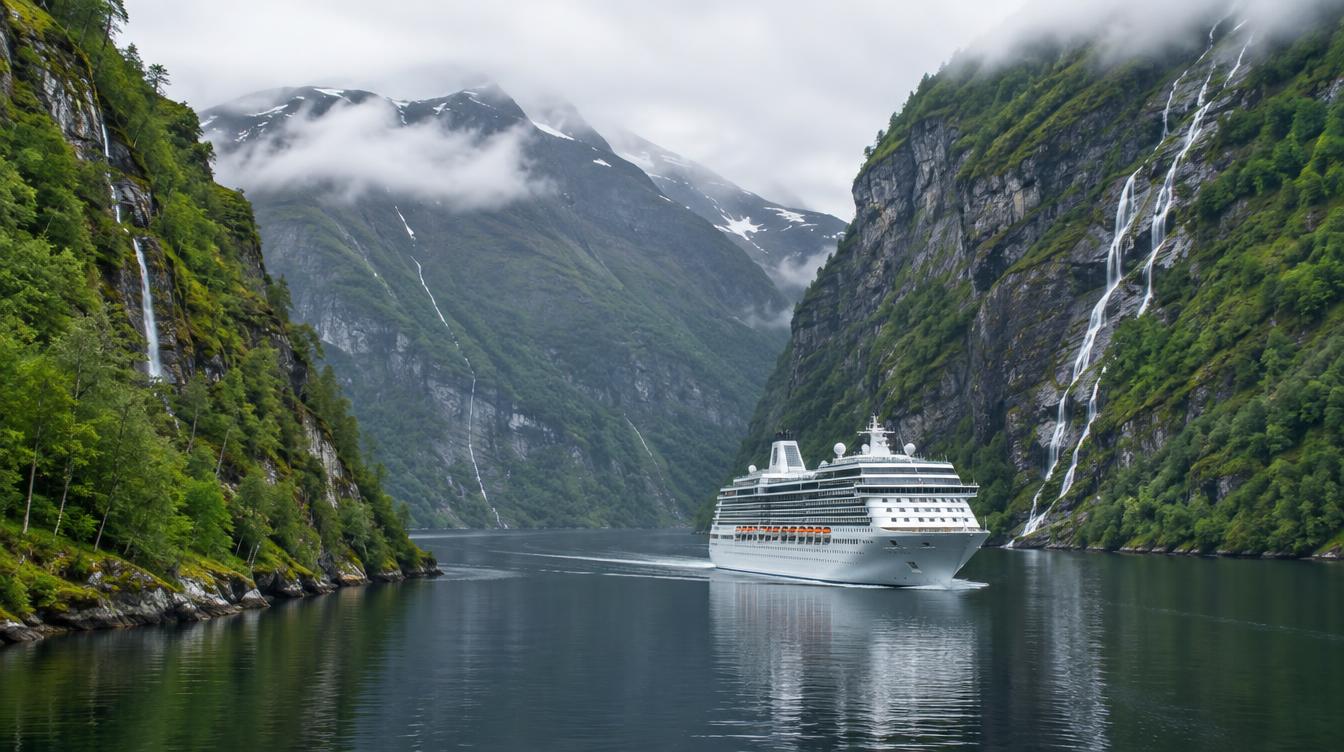
- The fjord season runs from about May to September. May and June bring full waterfalls and long days. July and August are warmest and busiest.
- The scenery is the destination. Be on deck for the sail in and out, which often happens early in the morning.
- Pack layers and a waterproof whatever the forecast. Bergen is famous for rain.
A fjord is a long, narrow inlet carved by a glacier and flooded by the sea. Norway has more than a thousand of them, and the largest reach over a hundred miles inland between walls of rock that rise thousands of feet from the water.
There are roads, tunnels and ferries. But a ship can sail to the very end of a fjord, turn in front of a waterfall and leave the way it came. For once, the cruise brochure photographs are not exaggerating.
When to go
The main season runs from May to September. Each part of it has a different character.
| Month | Daylight | What to expect |
|---|---|---|
| May | Long and growing | Snow on the peaks, waterfalls at full power, cool and quieter |
| June | Longest of the year | Mild, green, midnight sun in the far north |
| July | Very long | Warmest, busiest, highest fares |
| August | Shortening slowly | Warm, busy, berries and wildflowers |
| September | Normal evenings return | Autumn colour, fewer ships, more rain |
Waterfalls are fed by melting snow, so they are most impressive in late spring and early summer and thinner by late August.
The weather
Coastal Norway is milder than its latitude suggests, thanks to the Gulf Stream. It is also changeable. Sunshine, cloud and rain commonly share a single afternoon.
Bergen, the usual gateway to the fjords, is one of the rainiest cities in Europe. Treat a dry day there as a gift.
In Norway there is no bad weather, the saying goes, only the wrong clothes. Pack accordingly.
The fjords to know
Itineraries vary, and the names can blur. A few are worth recognising.
- Geirangerfjord is the classic: a narrow, winding fjord lined with waterfalls, and a World Heritage site.
- Sognefjord is the longest and deepest in Norway, stretching more than 120 miles inland.
- Naeroyfjord, a narrow branch of Sognefjord, is also a World Heritage site and is reached from Flam.
- Hardangerfjord is gentler, known for fruit orchards and blossom in May.
- Lysefjord, near Stavanger, is home to the famous cliff known as Pulpit Rock.
The ports
Most fjord cruises call at a combination of the following.
| Port | Known for | Good to know |
|---|---|---|
| Bergen | Colourful wooden wharf, funicular, fish market | Walkable from the pier, bring a raincoat |
| Flam | The steep Flam Railway and Naeroyfjord | Railway tickets sell out, book early |
| Geiranger | Viewpoints high above the fjord | Often a tender port |
| Alesund | Art Nouveau architecture, hilltop viewpoint | Compact and easy on foot |
| Stavanger | Old town of white wooden houses, Lysefjord trips | Ship docks beside the centre |
| Olden | Access to a glacier valley | Small village, excursions needed |
Several of these are small villages at the head of a fjord. The ship may anchor and ferry passengers ashore by tender.
The scenic sailing
The highlight of a fjord cruise is often not a port at all. It is the hours the ship spends gliding up a fjord to reach one.
These passages frequently happen early in the morning. Check the daily programme the night before and set an alarm. Being on deck with a hot drink as the ship turns into Geirangerfjord at six o'clock is the reason you came.
On the way out, the same scenery appears in different light. Find a spot on an open deck forward, where you can see both sides.
Cabin choice
This is an itinerary where a balcony earns its price. You will use it for hours, at odd times of day.
If the budget does not stretch, do not worry. The open decks are free, less crowded than you might expect at dawn and show you both walls of the fjord at once.
The far north
Longer itineraries continue beyond the fjords to the Lofoten Islands, Tromso and the North Cape. North of the Arctic Circle, the sun does not set for several weeks around midsummer.
The midnight sun is a remarkable experience and makes sleep difficult. Bring an eye mask.
Northern lights require darkness, so they are a feature of autumn and winter voyages, not summer ones.
What to pack
Dress in layers that you can add and remove through the day.
- A waterproof jacket with a hood, and ideally waterproof trousers.
- A warm mid-layer such as a fleece or light down jacket.
- Comfortable walking shoes with good grip.
- A hat and gloves, even in July, for early mornings on deck.
- Binoculars and an eye mask.
Evenings on board are generally relaxed. Leave formal wear at home unless your cruise line specifically calls for it.
Costs ashore
Norway is expensive. A coffee and a pastry in a harbour cafe will cost noticeably more than at home, and restaurant meals more still.
Many passengers eat lunch on the ship and spend ashore on experiences instead. Cards are accepted almost everywhere, so there is little need for cash.
Excursions worth considering
A few experiences are hard to arrange independently in the time available: the Flam Railway, a coach to a high viewpoint above Geiranger, a small-boat trip into a narrow side fjord.
Book these in advance, since capacity is limited. For ports such as Bergen, Alesund and Stavanger, walking on your own is easy and rewarding.
Getting there
Fjord cruises commonly sail round trip from ports in the United Kingdom, the Netherlands, Germany and Denmark, with a sea day or two each way. Some begin in Bergen itself.
Round-trip sailings from northern Europe are convenient. Those starting in Norway give more time among the fjords.
Is it for you?
A fjords cruise is about landscape. If you want beaches, nightlife and guaranteed sunshine, look elsewhere.
If the idea of watching a waterfall fall a thousand feet into still water, from a deck chair, wrapped in a blanket, sounds like a holiday, there are few better trips anywhere.
Frequently asked questions
When is the best time to cruise the Norwegian fjords?
May to September. Late May and June offer long daylight, snow on the peaks and waterfalls at full strength. July and August are the warmest and most crowded. September is quieter, with autumn colour and a small chance of northern lights on more northerly itineraries.
Do I need a balcony cabin for a fjords cruise?
It is one of the itineraries where a balcony gives the most value, because the ship spends hours sailing close to dramatic scenery. It is not essential: the open decks are free and offer views on both sides, which a balcony does not.
Can you see the northern lights on a summer fjords cruise?
Not in midsummer, when northern Norway has daylight around the clock. The aurora is visible only when the sky is dark, broadly from late September to March, and is most likely on voyages that travel well north.